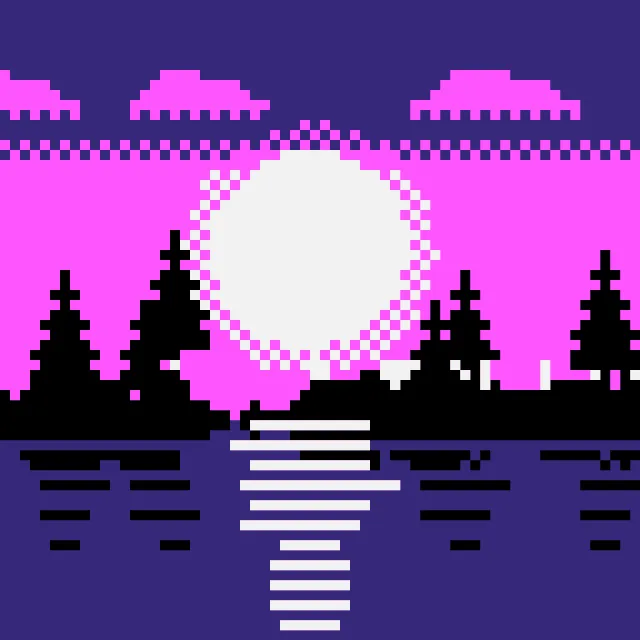
A party of 16-bit game characters, each put together from parts, shaded with a few colours and outlined, idling, walking and cheering at a console’s pace.
What makes it Sprites
These are the design choices this generator makes or lets you set. Where a choice says “Measured”, Morphogeny changed that control alone, kept everything else, and measured the picture: a number that moves with the choice, not proof that the picture reads as the style.
- Content held in borders, cartouches or compartments. “Layout”: Character select.
- Repeated units create a visual cadence. “Layout”: Roster sheet.
- Simplified, flattened people and objects. Set by “Stylised figure”.
- Speed, machines, progress and the future. “Stylised figure”: Robots.
- Smooth blends, fades or spectral ramps. “Backdrop”: Banded sky.
- Light elements on black or deep fields. “Backdrop”: Night. Measured on the opening picture with “Night”: brightness of the ground 1.8%.
- Unmodulated areas of colour. “Backdrop”: Flat colour. Measured on the opening picture: area in flat colour 86% with “Flat colour”, 71% with “Banded sky” and 71% with “Night”.
- Two or three flat inks. “Limited spot colours”: Palette only.
- Orthogonal bars, blocks and lines. Always.
- Systematic icon families. Always.
- Humour, games, visual puns. Always.
- Deliberate reference to an earlier period. Always.
How this generator works
- Every character is a front-facing sprite on one coarse pixel grid, assembled from parts and shaded with four-tone ramps lit from the top left, in colours cut to 15 bits; nothing is smooth, blurred or anti-aliased.
- Characters move as console sprites do, in whole frames at about six a second, each out of step with the others.
What it never does:
- No character, creature, name or logo from any game, and no copy of a known sprite: every character is put together by the seed from generic parts (species, jobs, hair, hats and tools).
- Not an anime idiom: small dot eyes and plain faces, no sparkling eyes or speed lines.
Every picture is a recipe: the variation number and the settings, kept in the page's address. Copy the link and the same picture comes back, in any browser. Random (or R) draws a new variation; ← and → step through them; S shuffles the settings; C borrows another style's colours.
About Bitmap & Pixel Graphics
Sprites are the small moving pictures of video games. On the 16-bit consoles of the early 1990s a character was a few dozen pixels tall and could use at most fifteen colours, so artists placed every pixel by hand: an outline round each part, three or four shades of each colour lit from one side, and a few frames for standing, walking and celebrating, stepped rather than moved smoothly.
This generator puts each character together from parts the seed chooses: a species (people, elves, animal folk, slimes, ghosts, skeletons, mushrooms, robots), a job with its clothes and tool, hair, a hat, and a plain face with small dot eyes. Every part is shaded with a four-tone ramp lit from the top left, its shadows leaning towards the palette’s darkest colour, and outlined; every colour is cut to 15 bits, as the consoles stored it. Stand a party on a stage under a banded sky or a starry night, fill a character-select screen with cards, names and health bars, or a whole roster sheet, and set a title in the bitmap font. To make one character yourself, pick a lead: its species, class, what it holds, headwear, hair, face and colour, while the seed fills in the rest of the cast.
When the picture moves, the characters idle, walk in place or cheer, each out of step with the others, in whole frames at about six a second, so no pixel changes more often than that and nothing flashes. A still is the first frame. Every character is new: none comes from a game, and the name on a card is only its species or job.
Bitmap & Pixel Graphics: 1977–1995. What the controls mean: Help.
Use it from code
The recipe below draws the picture this page opens with. Copy recipe gives you the one on screen. Agents can render recipes to SVG or PNG through Morphogeny's MCP server (morphogeny_render); the same recipe always gives the same SVG.
{
  "tool": "sprites",
  "v": 1,
  "seed": 17,
  "format": "square",
  "params": {
    "layout": "party",
    "cast": "mixed",
    "count": 3,
    "size": 32,
    "action": "mixed",
    "stage": "sky",
    "outline": "colour",
    "tones": "natural",
    "title": "Choose your hero",
    "name": "",
    "lead": "any",
    "job": "any",
    "held": "any",
    "headwear": "any",
    "hair": "any",
    "face": "any",
    "colour": "any"
  },
  "palette": "bitmap-pixel"
}
Open this recipe: /sprites/#seed=17&v=1. A plain-text version of this page:/sprites.md.