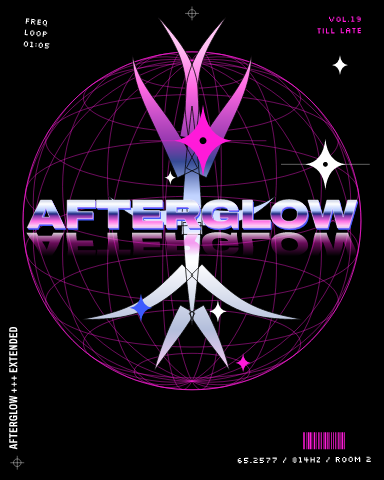
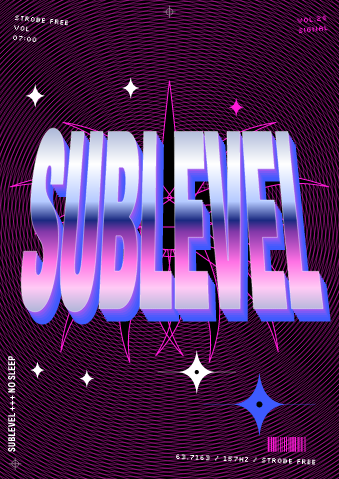
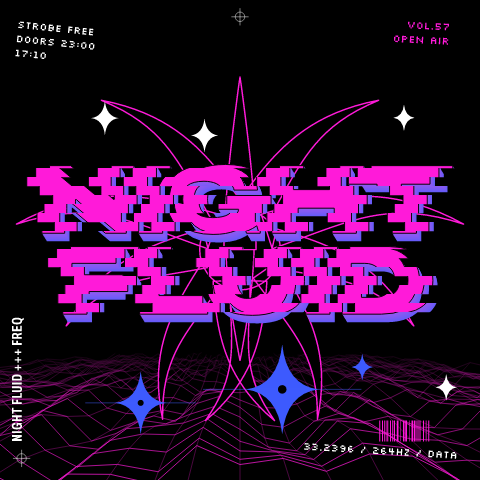
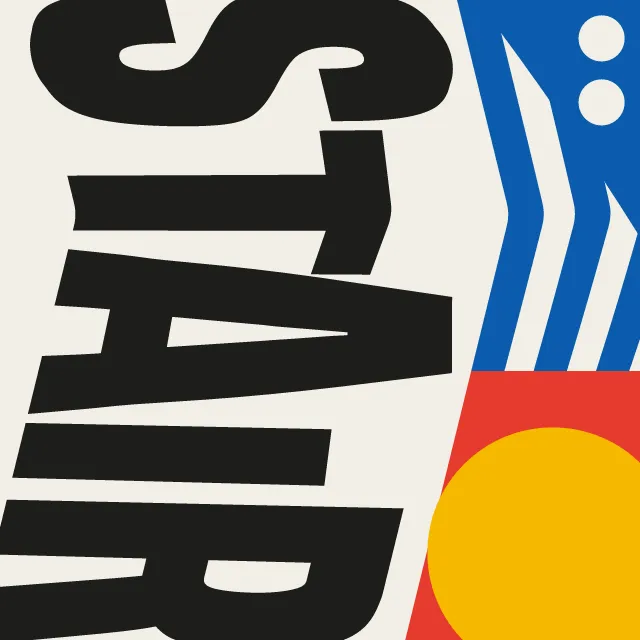
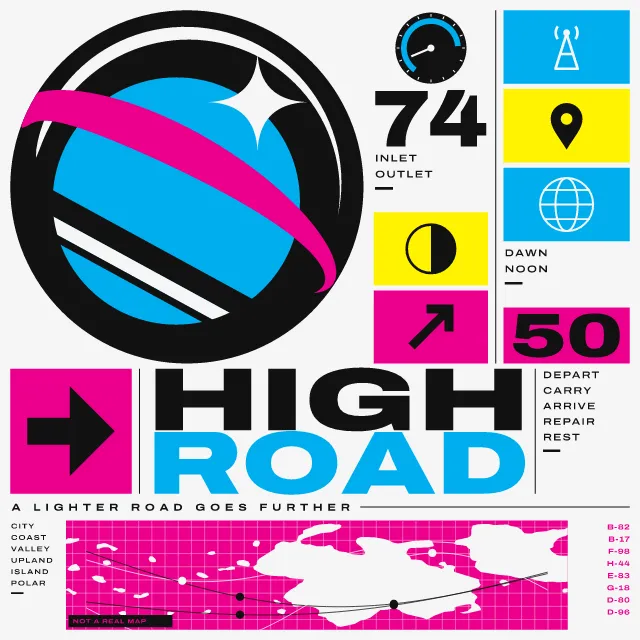
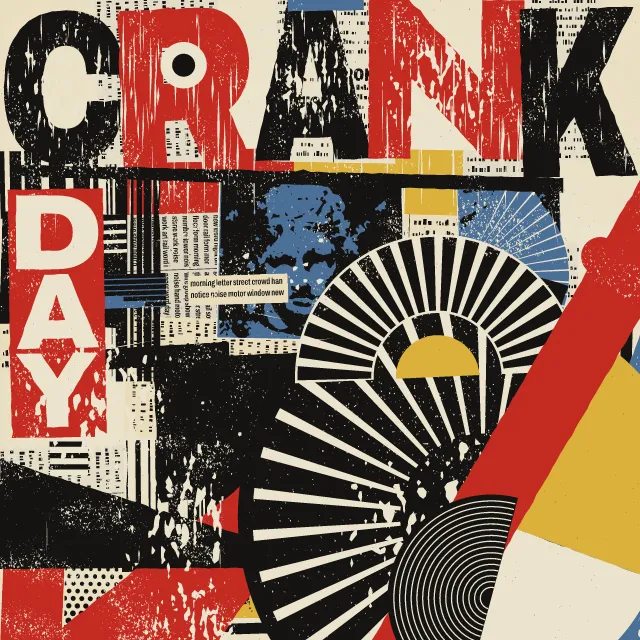
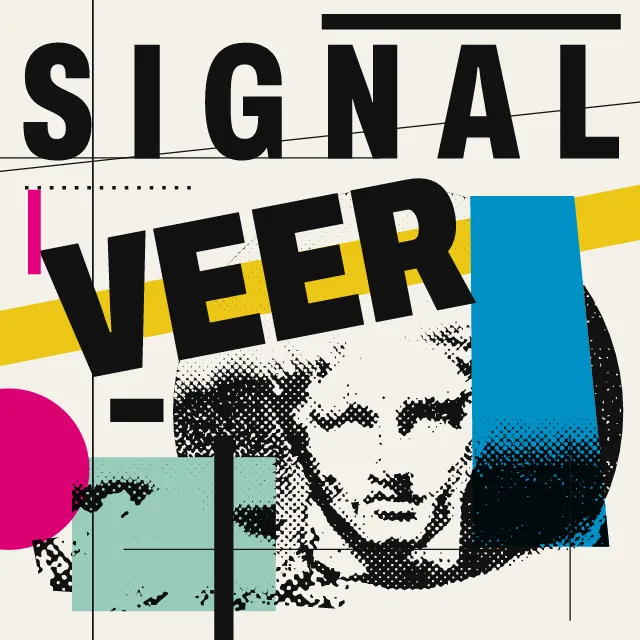

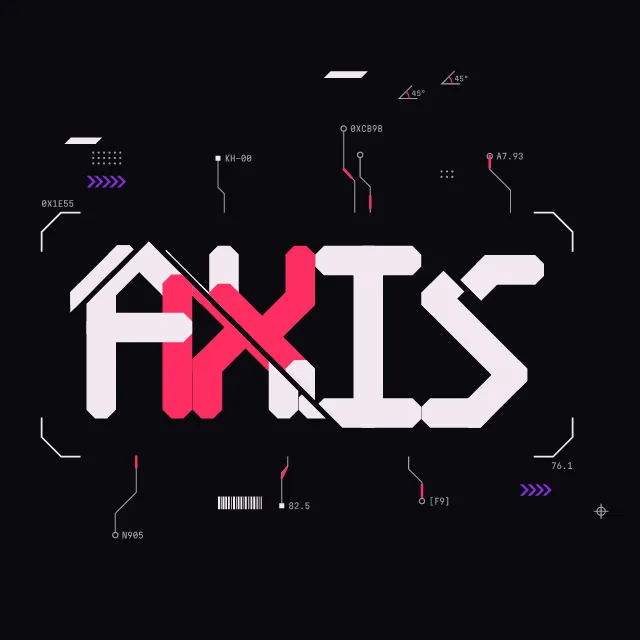

Your words in liquid chrome, melted, stretched, mirrored or sliced, over hooked thorns, a wireframe and scattered sparkles on a night ground.
What makes it Acid Graphics
These are the design choices this generator makes or lets you set. Where a choice says “Measured”, Morphogeny changed that control alone, kept everything else, and measured the picture: a number that moves with the choice, not proof that the picture reads as the style.
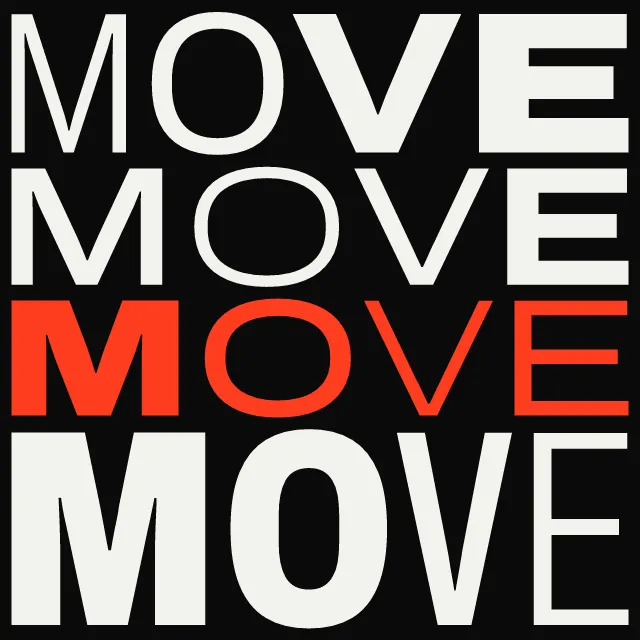
- Stretched, fragmented, layered or deliberately hard-to-read letters. Set by “Experimental & distorted”.
- Letters so large they become the picture. “Experimental & distorted”: Stretched tall.
- Elements mirrored around a central axis; formal and stable. “Experimental & distorted”: Mirrored.
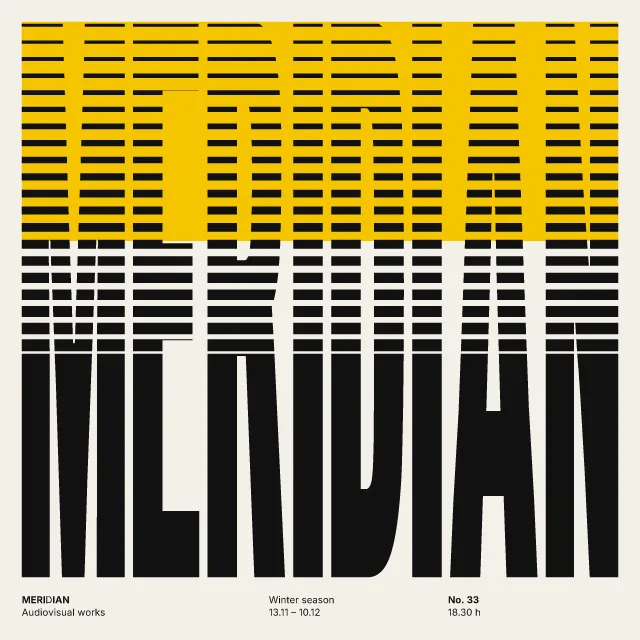
- Corrupted pixels, scanlines, compression artefacts. “Experimental & distorted”: Sliced.
- Metallic, rendered, ray-traced forms. Set by “Chrome & 3D render”.
- Perspective, overlap, shadow or parallax create a z-axis. Set by “Illusion of depth”.
- Sinuous, energetic S-curves. Set by “Whiplash thorns”.
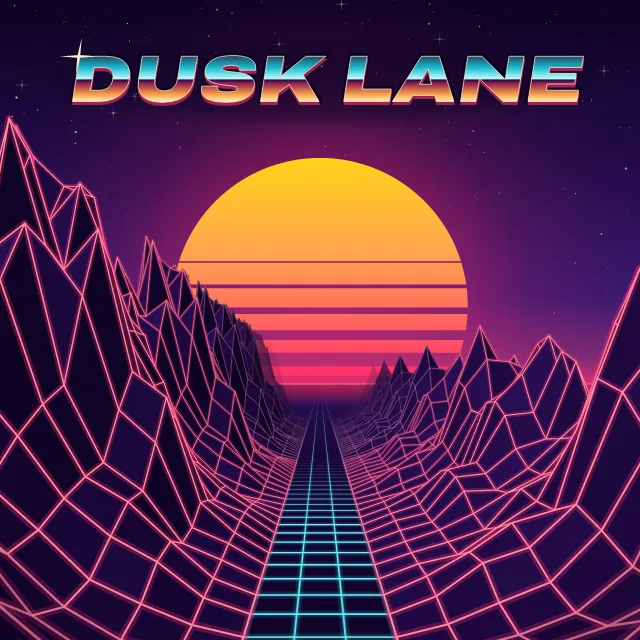
- Computer-generated objects, scenes and textures. “Wireframe”: Terrain.
- Repeated lines and modules that vibrate or warp perception. “Wireframe”: Ring moiré.
- Stars, suns, orbits, sparkles and planets. Set by “Cosmic & celestial”.
- A grid is implied and then deliberately violated or deconstructed. Set by “Broken grid”.
- Light elements on black or deep fields. “Ground”: Dark ground. Measured on the opening picture with “Dark ground”: brightness of the ground 0.0%.
- Day-glo inks and RGB brights. Always.
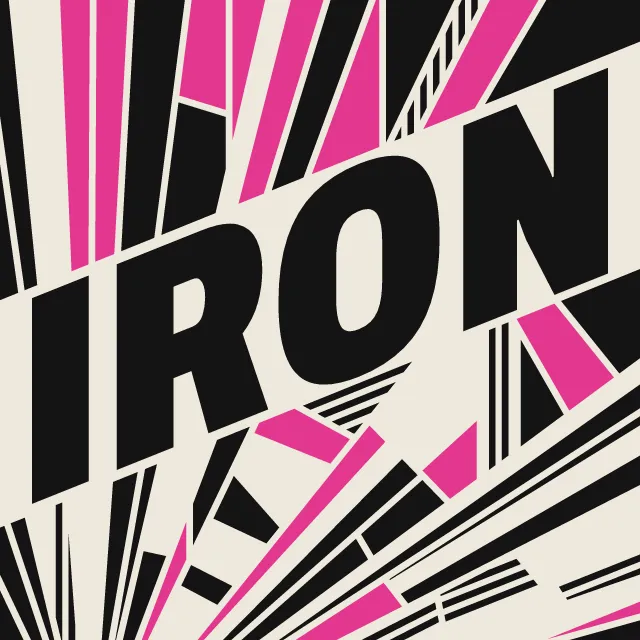
- Deliberate instability: crowded edges, clashes, near-collisions. Always.
- Many typefaces and sizes combined in one composition. Always.
- Against authority, taste or convention. Always.
How this generator works
- One word as liquid chrome: an ultra-wide or ultra-condensed grotesque filled with a horizon reflection (bright sky, dark line, acid-tinted ground), extruded into depth, then melted into drips, waved, stretched, mirrored or sliced.
- Behind it a mirror-symmetric emblem of hooked, tapering thorns and a wireframe terrain, globe or ring moiré in one acid ink; sparkle stars and small bitmap type knocked off the grid at the edges.
What it never does:
- No logos, band or club names, and no particular poster or record sleeve: the default word, thorns and furniture are made up by the seed. No smiley faces, no blackletter imitation, no real dates or places.
Every picture is a recipe: the variation number and the settings, kept in the page's address. Copy the link and the same picture comes back, in any browser. Random (or R) draws a new variation; ← and → step through them; S shuffles the settings; C borrows another style's colours.
About Acid Graphics / New Ugly
Acid graphics, also called the New Ugly, grew out of club flyers and record sleeves in the late 2010s. Designers took the rave and early-web graphics of the 1990s and remade them with 3D software: lettering turned to liquid metal, symmetric spiky ornaments, wireframe grids, sparkle stars and acid green on black, packed together until the page feels deliberately too much.
This generator builds that page from rules. The words are set in an ultra-wide or ultra-condensed grotesque, filled with a chrome reflection (bright sky, dark horizon, tinted ground), extruded, then bent. Behind them sit a mirror-symmetric emblem of tapering, hooked thorns and a wireframe terrain, globe or ring moiré; small bitmap type and marks are thrown off the grid at the edges.
The thorns, drips, stars and furniture come from the variation number, so every seed is a new sheet rather than a copy of a known poster. Swap in another palette and the chrome is rebuilt from its lightest and darkest colours and its most saturated ink.
Acid Graphics / New Ugly: 2016–today. What the controls mean: Help.
Rave flyers, chrome type and the New Ugly
The roots are in the rave flyers of the early 1990s. Club nights were announced on small printed handbills crowded with chrome logos, fluorescent inks and spiky ornament, every inch filled. The late 1990s added the silver optimism of Y2K graphics and the distressed type of grunge.
From about 2016, designers of European club posters and record sleeves went back to that material with 3D software that could render real reflections. The work spread through an online collection on social media, and the name acid graphics stuck. It set itself against clean corporate minimalism and the friendly flat illustration of tech brands, mixing blackletter, ultra-wide grotesques and pixel faces until the page was deliberately hard to like. The look is still common on club and gig posters, record covers and merchandise.
How the generator makes liquid chrome lettering
Type up to 32 characters in Words; they are set in capitals on up to three lines, as large as the sheet allows. Experimental & distorted bends the letters: Melting, Liquid wave, Stretched tall, Mirrored in a fading floor, or Sliced into shifted bands. Chrome & 3D render runs from a flat acid ink to full chrome, and Illusion of depth sets how far the letters are extruded.
Whiplash thorns sets how many pairs of hooked thorns the symmetric emblem has, from none to nine. Wireframe chooses what lies behind: Terrain, Globe, Ring moiré, or None. Cosmic & celestial scatters up to 16 four-pointed sparkles where they find room off the word.
Broken grid sets how far the small bitmap type is knocked off the grid and how far sliced letters shift. Ground takes the palette’s darkest colour for a night sheet, or the palette’s own ground for a printed, daylight version.
Acid graphics for club posters, covers and loops
The obvious use is a poster or flyer for a club night, a gig or a release party, printed from the Poster format at A3 or larger. Square makes a record or playlist cover, Story a vertical announcement, and Banner an event page header.
With motion on, the reflection runs through the chrome, the terrain rolls towards you and the globe turns. That makes a looping video for a screen behind a DJ or a social post. Export SVG, PNG or video; what you make is yours to use.
How to make an acid graphics poster that still reads
One short word carries the style best; a long phrase sets small and the chrome loses its drama. Melting needs room under the letters, so give it a tall format, and Stretched tall suits Story and Poster.
The style is meant to be crowded, but the word should still win. When the wireframe is busy, lower Whiplash thorns or Cosmic & celestial before you touch the chrome. In Banner the small type is very small, so treat it as texture. Before printing, proof the chrome on paper: the dark horizon and black ground can merge into one mass on uncoated stock.
Use it from code
The recipe below draws the picture this page opens with. Copy recipe gives you the one on screen. Agents can render recipes to SVG or PNG through Morphogeny's MCP server (morphogeny_render); the same recipe always gives the same SVG.
{
  "tool": "acid-graphics",
  "v": 1,
  "seed": 3,
  "format": "portrait",
  "params": {
    "word": "Voltage",
    "letterform": "melt",
    "chrome": 1,
    "depth": 0.5,
    "thorns": 5,
    "backdrop": "terrain",
    "stars": 7,
    "tension": 0.5,
    "ground": "dark"
  },
  "palette": "acid-graphics"
}
Open this recipe: /acid-graphics/#seed=3&v=1. A plain-text version of this page:/acid-graphics.md.