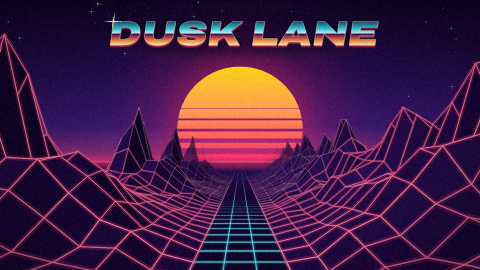
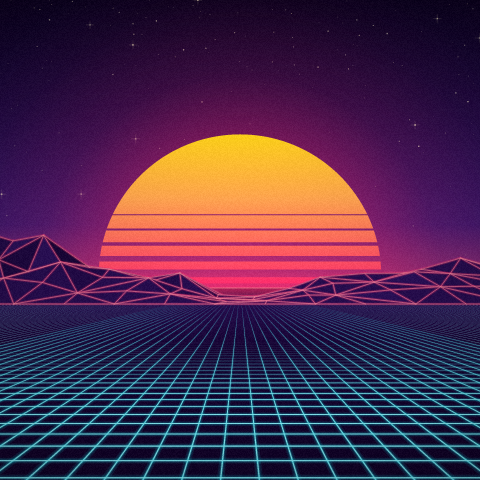
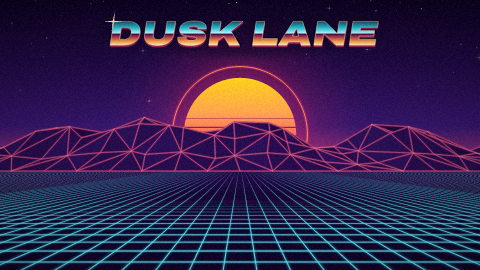
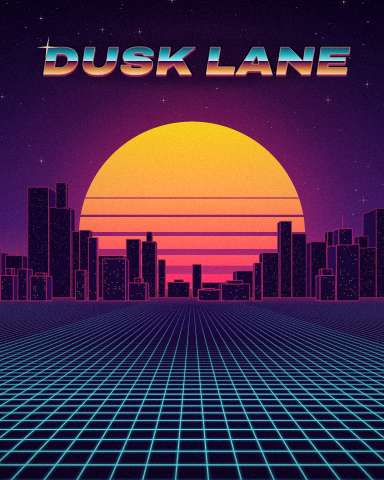
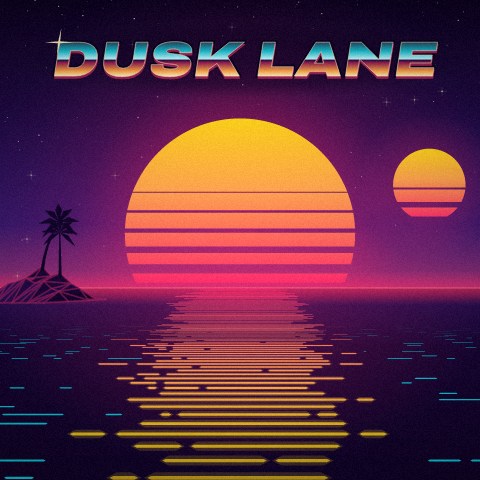
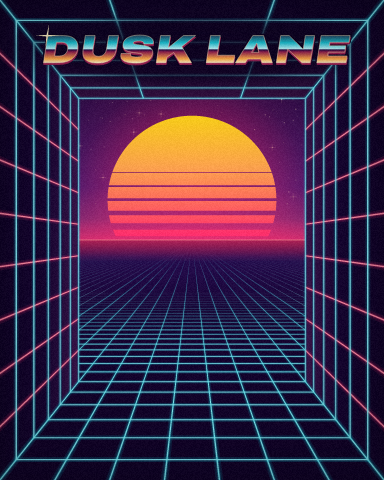
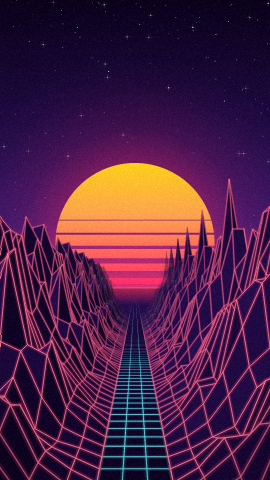
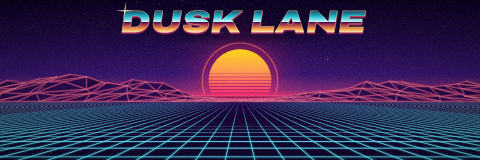
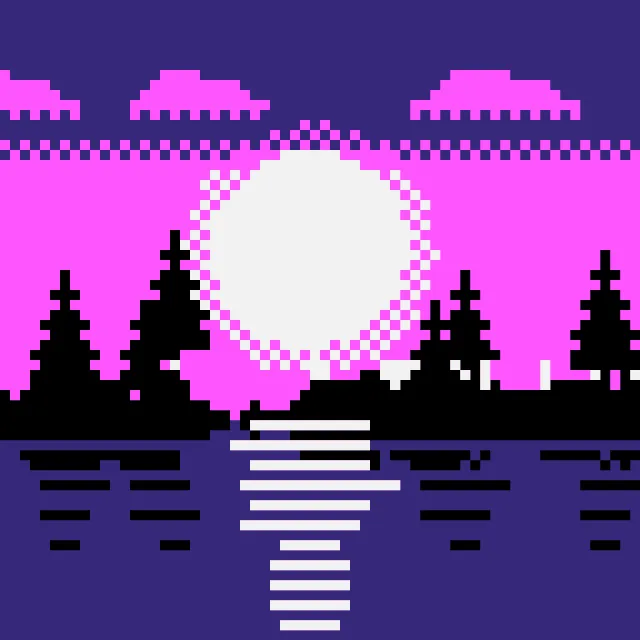




A night scene built in space and seen from one eye: a glowing grid to the horizon, a banded sun behind it, and wireframe land the seed draws anew each time.
What makes it Synthwave
These are the design choices this generator makes or lets you set. Where a choice says “Measured”, Morphogeny changed that control alone, kept everything else, and measured the picture: a number that moves with the choice, not proof that the picture reads as the style.
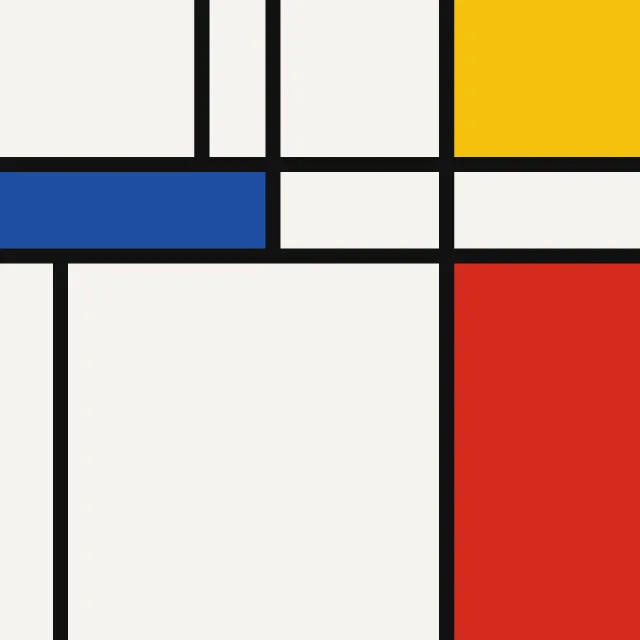
- Perspective, overlap, shadow or parallax create a z-axis. Set by “Illusion of depth”.
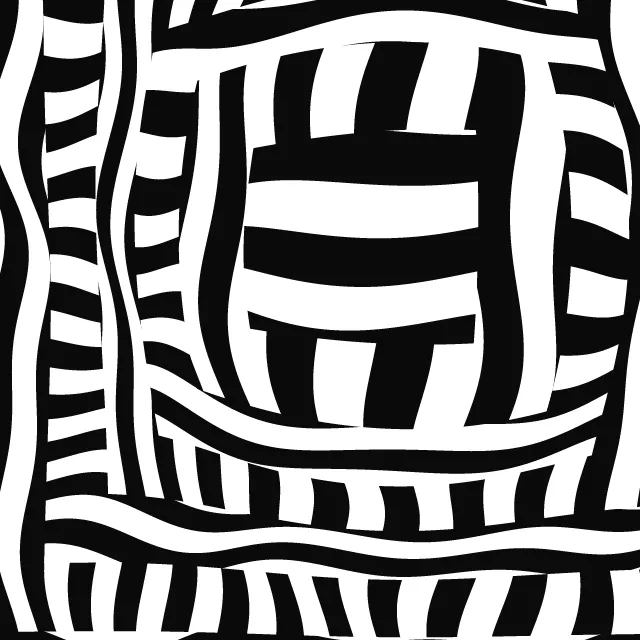
- Repeated units create a visual cadence. Set by “Repetition & rhythm”. Measured on the opening picture, from 6 to 24: pixels on an edge 33% → 45%.
- One unmistakable point of entry. Set by “Single focal point”.
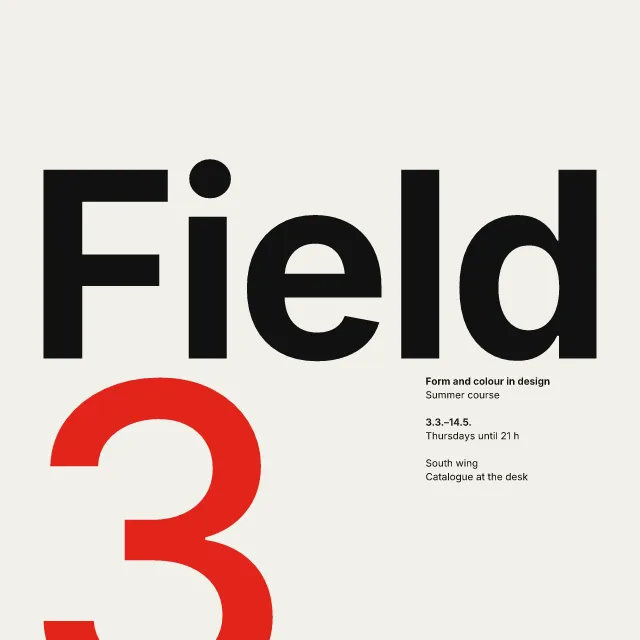
- Thick bars, lines and dots as structural accents. Set by “Rules & bars”. Measured on the opening picture, from 0 to 12: long thin shapes 44 → 67.
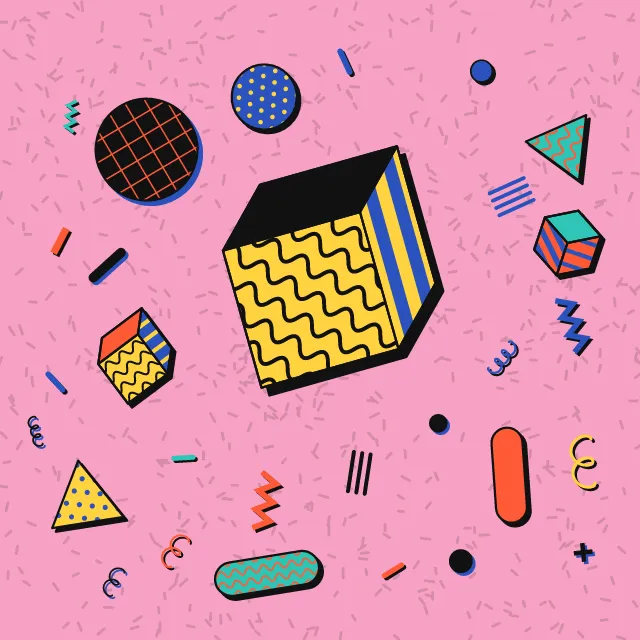
- Chevrons, zigzags, sunbursts and faceted shards. Set by “Angular & zigzag”. Measured on the opening picture, from 0 to 1: curved segments 21% → 9.0%.
- Stars, suns, orbits, sparkles and planets. Set by “Cosmic & celestial”.
- Animated, time-based work: titles, broadcast, video. Set by “Motion & broadcast”.
- Elements mirrored around a central axis; formal and stable. Always.
- Day-glo inks and RGB brights. Always.
- Light elements on black or deep fields. Always.
- Smooth blends, fades or spectral ramps. Always.
How this generator works
- One ground plane seen from one eye: a grid of lines runs to a vanishing point in the middle of the horizon, and every line thins and fades with its distance.
- A plain banded sun stands behind the horizon in a graded night sky; wireframe land rises from the plane and hides what lies behind it.
- It is always night: the darkest colour of any palette becomes the ground, and its brightest colours the lines and the sun.
What it never does:
- The sun is only ever a plain disc cut by level bands: no rays, no wheel, no emblem. No line of the grid runs on to it, no star or mast stands on it, and only land in front of it covers its foot. No statue, bust, bird or slogan anywhere.
- No vehicle, figure, brand or film title, and no blur: glow is stacked strokes and gradients that fade to nothing.
- It only ever goes forwards, and no line passes a spot more than about one and a half times a second.
Every picture is a recipe: the variation number and the settings, kept in the page's address. Copy the link and the same picture comes back, in any browser. Random (or R) draws a new variation; ← and → step through them; S shuffles the settings; C borrows another style's colours.
About Synthwave
Synthwave is the look that grew up from the mid-2000s around electronic music that looks back at the 1980s: record sleeves, posters and screens that recall the decade’s arcades, film posters and video tape. Its picture is nearly always the same one. A glowing grid runs in one-point perspective to a horizon, a large sun stands on it, graded from yellow to magenta and cut by level bands, and everything is lit as if at night, in magenta, cyan and violet on near-black.
This generator builds that scene in space rather than drawing it flat. There is one ground plane and one eye above it; the grid, the wireframe mountains, the blocks of a far skyline with a few lit windows, the island and the tunnel are placed on the plane and seen through one camera, painted from far to near so that land hides what lies behind it. Lines thin and fade with distance, and the glow is made of stacked strokes and gradients, so the file stays sharp vector. You choose the scene, the height of the horizon, the grid, the size of the sun and its bands, the height of the land, the stars and a title in chrome; the seed draws the land, the sun and the sky. It is always night: borrow any palette and its darkest colour becomes the ground, its brightest the lines and the sun.
It moves forwards only. The grid and the land come towards you over ground that repeats, the gaps in the sun sink through the disc while new ones enter at the top, or both, in a loop that closes without a seam. Download the still as SVG or PNG, or the loop as a video.
Synthwave: 2006–today. What the controls mean: Help.
Where synthwave and retrowave come from
Synthwave began as music before it was a picture. In the mid-2000s, electro and house producers in France and synthesizer musicians in online communities started making tracks that looked back to the film and game soundtracks of the 1980s. Producers in Sweden, Australia and North America followed, along with game studios and illustrators. The scene also goes by retrowave and other names.
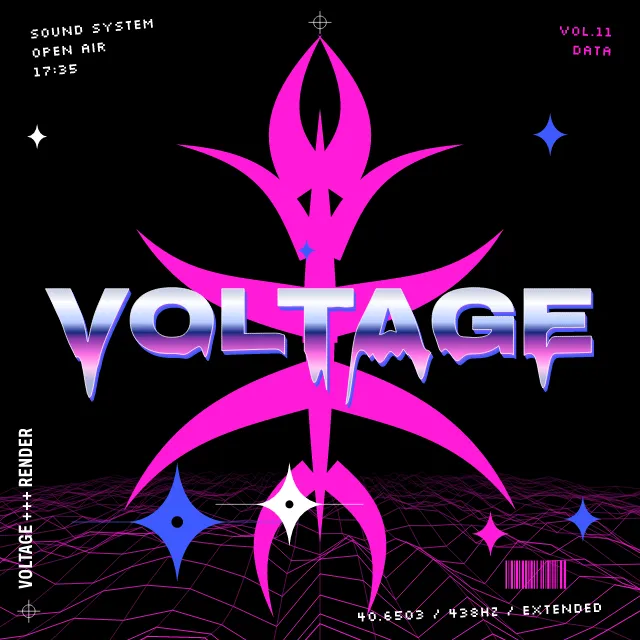
Its visuals settled between about 2010 and 2013, as the music reached film soundtracks and video games. They borrow from the posters, arcade cabinets and tape covers of the decade it remembers. Titles are chrome-bevelled with a star glint and a hot-pink brush script beneath, palms and sports cars stand against the horizon, and tracking noise runs over the whole. The mood runs from brooding night drives to affectionate parody, and the look still dresses record sleeves, game key art and club nights for that music.
How the generator draws a neon grid and sunset
The world is measured in eye heights. Each line of the grid is a strip that narrows with distance, as a painted line on a road would, drawn three times: a wide faint stroke, a middle one and a pale core. Land is a field of points painted row by row from the farthest, each facet filled dark and then lined, so a nearer ridge covers the lines behind it.
Illusion of depth sets the scene, from Open plain to Tunnel, and Horizon how much sky it leaves. Repetition & rhythm sets how many cells cross the foot of the sheet, Single focal point the size of the sun, and Rules & bars how many level gaps cut it. Angular & zigzag raises the land, and Cosmic & celestial fills the sky with stars. The Title is set in a wide, leaning grotesque filled with chrome, with a pale rim and one four-pointed glint.
What to make with a synthwave background
With your own words in the Title, the picture becomes a cover or a poster. A square suits a single or album cover, the A3 poster at 300 dpi a club night or a screening, and the Story format a teaser for social media.
Without a title, the Landscape format makes a slide or a stream background, and the Banner a header for a page about music or games. The Video button records the loop chosen under Motion & broadcast: the grid drives towards you, the gaps in the sun sink, or both. The loop closes on itself, so it can repeat behind a live set or a playlist. The SVG, PNG and video are yours to use.
How to make a good synthwave picture
Keep the title to a word or two. It sits above the sun only where the sky has room, so a horizon set high on the sheet with a large sun moves it down over the ground. Fewer cells give bold lines near the eye; more give a finer, calmer floor.
The sun stays a plain banded disc, with no rays or emblem, because extremist imagery has borrowed this look by swapping the sun for a symbol. At no bands the disc is whole, but Bands sink then has nothing to move. The grain and darker corners of the Dusk look are left out of the SVG, so export a PNG to keep them. Near-black grounds print darker than they look on screen, so check a proof.
Use it from code
The recipe below draws the picture this page opens with. Copy recipe gives you the one on screen. Agents can render recipes to SVG or PNG through Morphogeny's MCP server (morphogeny_render); the same recipe always gives the same SVG.
{
  "tool": "synthwave",
  "v": 1,
  "seed": 1,
  "format": "landscape",
  "params": {
    "scene": "valley",
    "horizon": 0.6,
    "grid": 12,
    "sun": 0.64,
    "bands": 6,
    "relief": 0.6,
    "stars": true,
    "title": "Dusk lane",
    "motion": "drive"
  },
  "palette": "synthwave-outrun"
}
Open this recipe: /synthwave/#seed=1&v=1&grain=amount:0.15,size:1.2,specks:0,vignette:0.4. A plain-text version of this page:/synthwave.md.