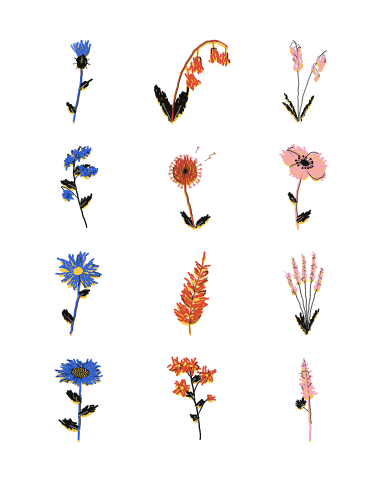
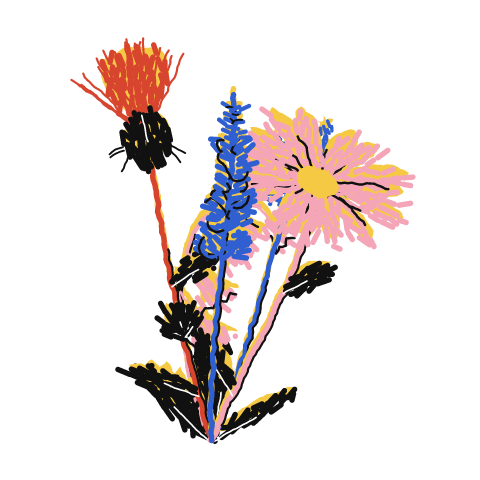
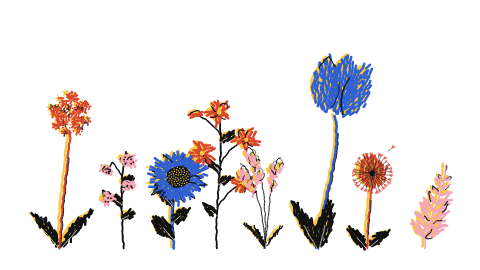
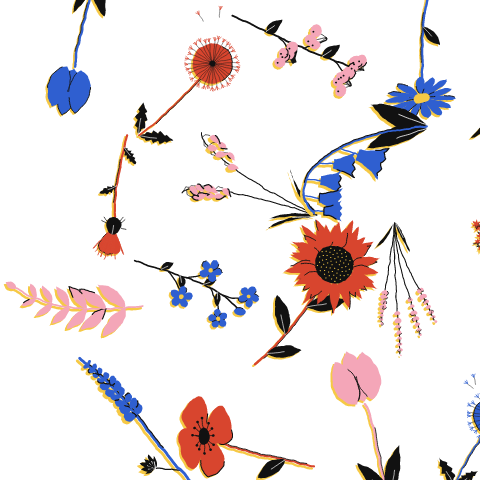
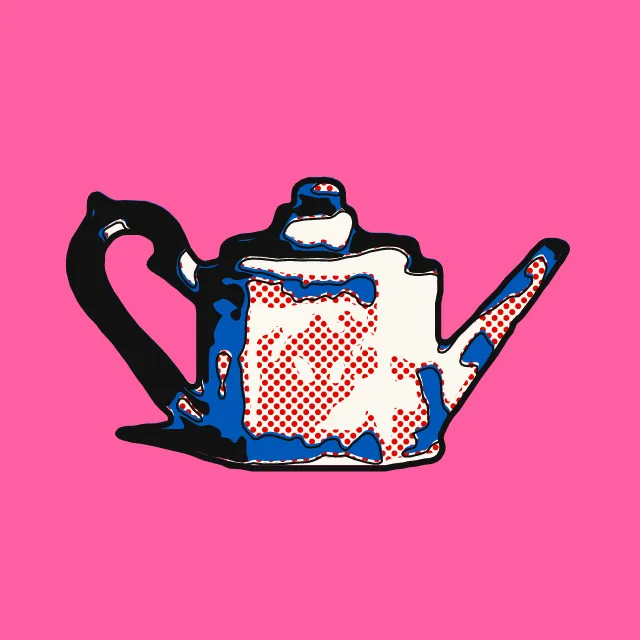


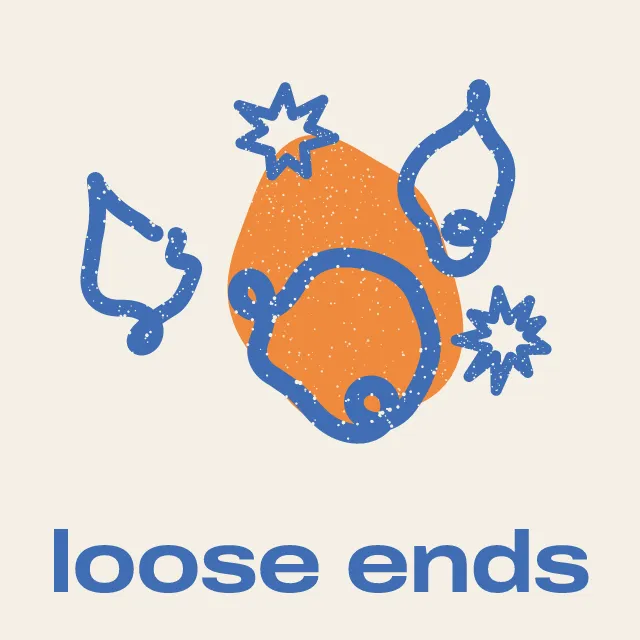
Flowers and plants drawn from code as if in a sketchbook: crayon dabs, scribble or line, a dark key ink, and a second ink printed a little out of line.
What makes it Scribble flora
These are the design choices this generator makes or lets you set. Where a choice says “Measured”, Morphogeny changed that control alone, kept everything else, and measured the picture: a number that moves with the choice, not proof that the picture reads as the style.
- A single object or figure isolated on a plain ground. “Layout”: One plant.
- One unmistakable point of entry. “Layout”: Bunch.
- Text and image follow curving, natural paths instead of a grid. “Layout”: Meadow.
- Direct manual drawing and writing in ink. “Marks”: Crayon dabs.
- Playful scribbles, dots and fragments scattered across the field. “Marks”: Scribble.
- Outline drawing, engraving, pen and ink. “Marks”: Line.
- Inks slightly out of register; transparent overprints. Set by “Misregistration & overprint”.
- Two or three flat inks. “Colours”: One colour. Measured on the opening picture with “One colour”: hues besides black, white and grey 2.
- Simplified, flattened people and objects. Always.
- Unmodulated areas of colour. Always.
- Friendly, inclusive, human-scaled. Always.
How this generator works
- Every plant is grown from parts (stem, leaves, petals, centre) and drawn with hand marks: rows of short crayon dabs along each petal, a back-and-forth scribble, flat cut shapes with ragged edges, or a wobbly outline; a dark key ink picks out a few edges and a stem.
- A second ink is printed under the colour and shifted one way for the whole sheet, so it shows along one side of every shape, as a misregistered drum does.
- One plant alone with room round it, a bunch, a meadow, a sheet of variations or a tossed pattern: a family of illustrations that belong together, not one picture.
What it never does:
- No photographs, gradients, shading or modelling: flat ink on a flat ground.
- No botanical accuracy and no copied illustration: fourteen plants of its own, each varied by the seed.
- No ruled lines or perfect curves: every edge wobbles a little.
Every picture is a recipe: the variation number and the settings, kept in the page's address. Copy the link and the same picture comes back, in any browser. Random (or R) draws a new variation; ← and → step through them; S shuffles the settings; C borrows another style's colours.
About Naive scribble branding
Brands that want to look made by people, not machines, have taken to loose drawings: a flower drawn in a few quick crayon strokes, flat colour, plenty of white round it. The trouble with drawing by hand is that a brand needs dozens of these, all alike in spirit and none the same.
This generator grows each plant from its parts (a stem, leaves, petals and a centre) and then draws it the way a hand would: short dabs of a crayon laid in rows along each petal, a back-and-forth scribble, flat shapes with ragged edges, or a wobbly outline. A dark key ink picks out a few edges, and a second ink sits under the colour, shifted a little to one side, like a print where one drum ran out of line.
Pick one plant or let the seed choose, and lay them out alone, as a bunch, a meadow, a sheet of variations or a tossed pattern. Every picture is vector, so the SVG stays sharp at any size.
Naive scribble branding: 2019–today. What the controls mean: Help.
Why brands use naive hand-drawn illustration
Since around 2019, some identities have kept a deliberately loose, unpolished hand inside work that is otherwise orderly: wobbly lines, simplified things, flat colour on a plain ground. One trend commentary reads it as a reply to sleek minimal sites and to pictures made by image models. A drawing that wobbles shows that someone made a choice.
Flowers suit the idiom well. Everyone knows how a daisy or a tulip goes, so a few marks are enough, and the gaps and slips become the charm. Printed in two or three spot inks that do not quite line up, they read like a riso zine or a sketchbook page, not a stock illustration.
How the generator draws a plant by hand
There are fourteen plants: a daisy, a sunflower, a poppy, a tulip, an allium (a ball of small star florets), bells along an arching stem, a blossoming sprig, a frond, a thistle, lavender, a dandelion clock, a lupin, oats and a twig of berries. Each is built from simple parts whose size, lean, tilt and number change with the variation, so no two daisies are the same.
Then each part is drawn. Crayon dabs are short, round-ended strokes laid in rows along a petal, so the marks follow its shape. Scribble runs a crayon back and forth across it. Cut shapes fill it flat, and Line draws only its outline, sometimes twice. Roughness sets how much every edge wobbles, Mark size how thick the crayon is, and Density how closely the marks are laid.
Misregistration & overprint shifts the second ink under the colour, one way for the whole picture, so it shows along one side of every shape. Colours gives every plant the next ink of the palette, or one ink for all. The palette can be any of Stylogeny’s or your own.
What to make with hand-drawn flowers
One plant with room round it is a spot illustration for a website, a card, a label or an empty state. A sheet of variations is a ready set for a brand, and its link draws the same sheet again; to use one plant on its own, set the layout to One plant and try seeds until one suits. A bunch suits a poster or a cover, a meadow sits along the bottom of a banner, and the tossed pattern makes wrapping paper, a background or a textile.
Export SVG to recolour or edit the plant in any vector program, or PNG at the size you need.
How to get a good hand-drawn look
Keep to a light ground and a palette of three or four inks: one dark ink for the key and the leaves, and two or three bright ones for the flowers. Leave the plant plenty of space; the style needs white round it.
Raise Roughness for a quick, loose sketch and lower it for a steadier hand. Small pictures read better with a larger Mark size, and a print at poster size looks good with smaller marks and more Density. If the second ink fights with the colour, set Misregistration & overprint to 0 and it disappears.
Use it from code
The recipe below draws the picture this page opens with. Copy recipe gives you the one on screen. Agents can render recipes to SVG or PNG through Morphogeny's MCP server (morphogeny_render); the same recipe always gives the same SVG.
{
  "tool": "scribble-flora",
  "v": 2,
  "seed": 2,
  "format": "portrait",
  "params": {
    "subject": "mixed",
    "layout": "single",
    "marks": "dab",
    "rough": 0.5,
    "shift": 0.6,
    "mark": 1,
    "fill": 0.7,
    "colours": "each"
  },
  "palette": "naive-scribble-branding"
}
Open this recipe: /scribble-flora/#seed=2&v=2. A plain-text version of this page:/scribble-flora.md.