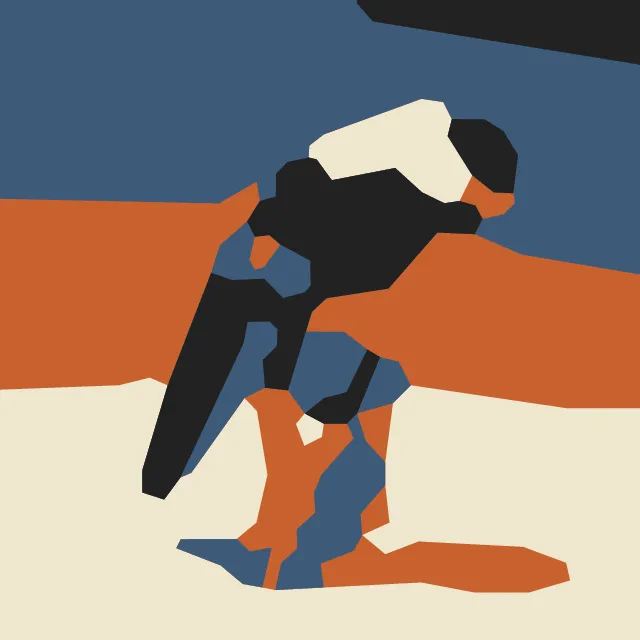
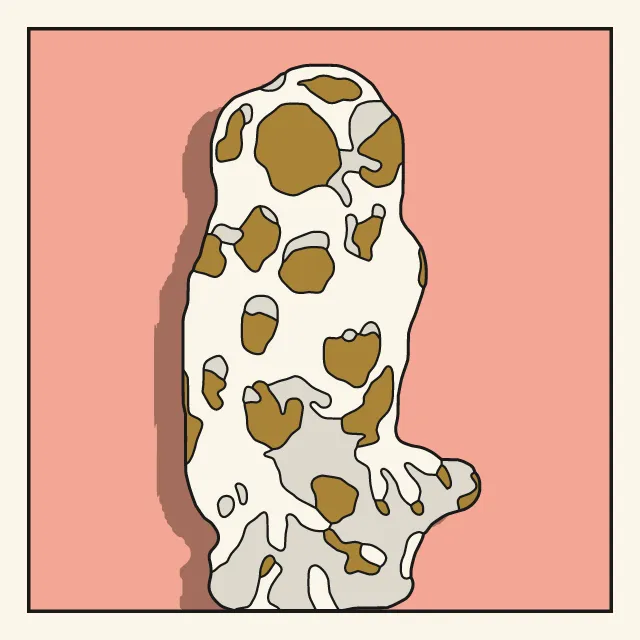

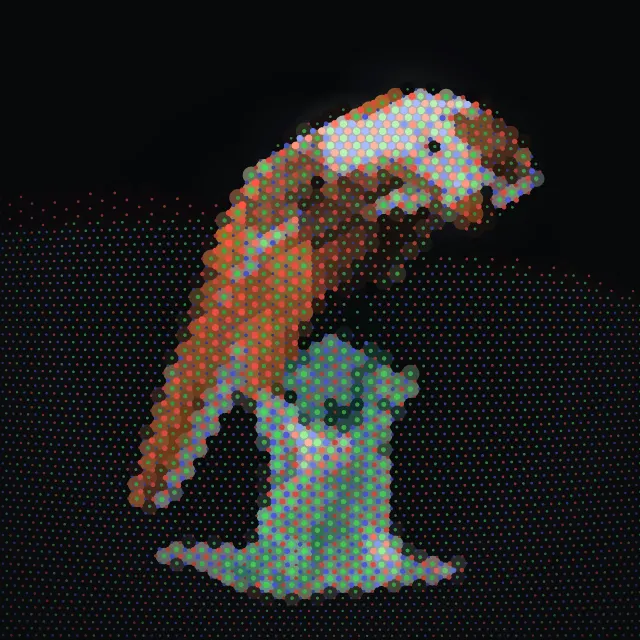

One-eyed characters sprayed freehand on a wall, with soft overspray, runs of paint and a tail that trails off in strands, tentacles or drips.
What makes it Spray ghosts
These are the design choices this generator makes or lets you set. Where a choice says “Measured”, Morphogeny changed that control alone, kept everything else, and measured the picture: a number that moves with the choice, not proof that the picture reads as the style.
- Simplified, flattened people and objects. Set by “Body”.
- Soft, cell-like, plant-like forms. Set by “Tail”.
- Visible brush, airbrush or paint handling. Set by “Overspray”.
- Stars, suns, orbits, sparkles and planets. “Second hand”: Sparks.
- Buildings, wayfinding, vehicles and the street. Set by “Wall”.
- A single hue, or black and white. “Paint”: Strongest contrast. Measured on the opening picture with “Strongest contrast”: hues besides black, white and grey 1.
- Two or three flat inks. “Paint”: One ink. Measured on the opening picture with “One ink”: hues besides black, white and grey 1.
- Outlines, speech balloons, character art. Always.
- Brush and paint applied directly to the final surface. Always.
- One unmistakable point of entry. Always.
- Against authority, taste or convention. Always.
How this generator works
- Characters, not letters: each is one soft blob of spray paint, a round head with a tail that trails off, splits into strands or hangs in tentacles, and a big eye left in the wall colour.
- The edge is overspray: rings traced at several distances outside the shape, painted faintly from the outside in, with specks in the halo, lighter sweeps inside and runs down every edge that faces the ground.
- A second hand may mark it in another colour: a loop over the head, an outline beside the shape or sparks around it.
What it never does:
- No lettering, tags or names: the wall carries characters only, so nobody’s handstyle or crew name is copied.
- No known cartoon or game character and no mascot: the characters are made by the seed from a head, a tail and eyes.
- In motion the characters float, sway and look around slowly, and blink once a loop; nothing pops in or out.
Every picture is a recipe: the variation number and the settings, kept in the page's address. Copy the link and the same picture comes back, in any browser. Random (or R) draws a new variation; ← and → step through them; S shuffles the settings; C borrows another style's colours.
About Graffiti & Hip-Hop Graphics
Next to the letters, graffiti has always had its characters: a face, a creature or a figure that a writer paints again and again until it becomes a signature of its own. The simplest are a single blob of black spray with one big eye left in the colour of the wall, quick enough to paint in a minute and easy to spot from across the street.
This generator grows those characters, not lettering. Each is one soft shape, a round head and a tail that thins, splits into strands, hangs in tentacles or melts into runs. Its edge is overspray: faint rings outside the shape, specks in the halo, lighter sweeps where the can passed quickly and paint running down wherever an edge faces the ground.
Every mark is a vector shape, and the same recipe always paints the same wall.
Graffiti & Hip-Hop Graphics: 1972–today. What the controls mean: Help.
Where graffiti characters come from
Graffiti grew up around names: writers painted their tags and pieces on trains and walls from the early 1970s and spent years refining their letters. Characters came along almost at once, painted beside a piece to give it a face: cartoon figures, b-boys, monsters and creatures, borrowed at first from comics and later invented by the writers themselves.
Some painters dropped the letters and let a character stand for them. Painted on doors, shutters and electricity boxes all over a city, the same simple figure works like a tag that anyone can read. Spray paint suits round, soft shapes: a full arm movement makes a disc, the edge blurs into overspray, and too much paint in one place runs down the wall.
How this generator paints a character
Each character is built from a circle for the head and a chain of tapering pieces for the tail, joined so smoothly that they read as one shape. The outline is then traced at several distances outside the edge and painted faintly from the outside in, which gives the soft fall-off of a spray can held at a distance. Specks are scattered through that halo, and wide, pale sweeps cross the inside where the coverage is uneven.
Paint runs down from every edge that faces the ground, more where Drips is high. The eyes are discs in the colour of the wall, sprayed on with their own soft edge, and each pupil looks somewhere of its own.
Body sets the head: round, egg, bean, lumpy, horned or spiked. Eyes go from one big eye to three in a row, a cluster, eyes all over or eyes on stalks, and Pupils and Mouth give each face its mood. Second hand adds lines in another colour, as if a second painter came by: a loop over the head, an outline, sparks, rays, a crown, arrows, a scribble, swirls or speed lines. With more than one character, Mixed crew gives each a different body, eyes and pupils and varies the mouth, tail and marks, while the controls set the largest one; switch it off for a crew of lookalikes.
What to make with spray-paint characters
A single big character on a pale wall makes a poster, a cover or an avatar with presence. A crew of characters in different sizes fills a banner, a flyer for a skate jam or a street-food night, or a slide background. The Door and Boards walls set a character in a scene, ready for a social post. In motion the characters float, sway their tails, look around and blink, a quiet loop for a story or a screen.
Tips for a good graffiti character
One big eye reads from furthest away; many eyes make a character stranger and better up close. Strands and Wisp suit tall formats, where the tail has room to trail off; Melting and Tentacles keep the character compact for square and wide ones.
Keep Overspray in the middle for the look of a can held at arm’s length; turn it right down for a crisp sticker-like shape. Strongest contrast paints the characters in the palette’s darkest colour on a light wall; Every colour paints the members of a crew in different colours, as many as the palette has.
Use it from code
The recipe below draws the picture this page opens with. Copy recipe gives you the one on screen. Agents can render recipes to SVG or PNG through Morphogeny's MCP server (morphogeny_render); the same recipe always gives the same SVG.
{
  "tool": "spray-ghost",
  "v": 1,
  "seed": 1,
  "format": "portrait",
  "params": {
    "cast": 1,
    "mix": true,
    "body": "round",
    "eyes": "one",
    "pupil": "dot",
    "mouth": "none",
    "tail": "strands",
    "spray": 0.6,
    "drips": 0.55,
    "scrawl": "halo",
    "wall": "plain",
    "paint": "black"
  },
  "palette": "seoul-independent-design"
}
Open this recipe: /spray-ghost/#seed=1&v=1&pal=seoul-independent-design. A plain-text version of this page:/spray-ghost.md.