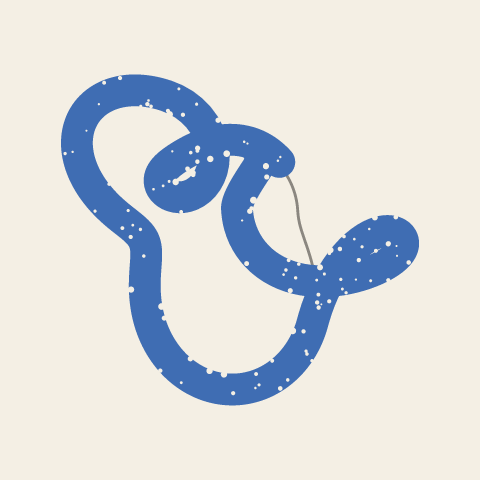
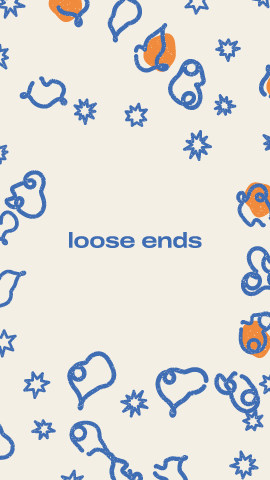
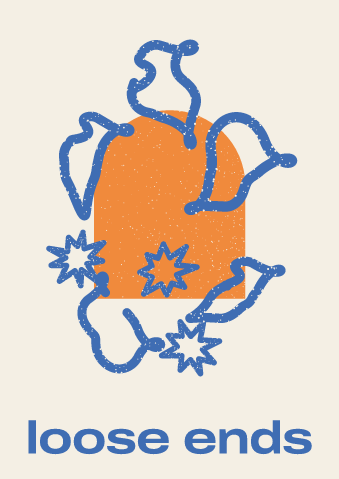
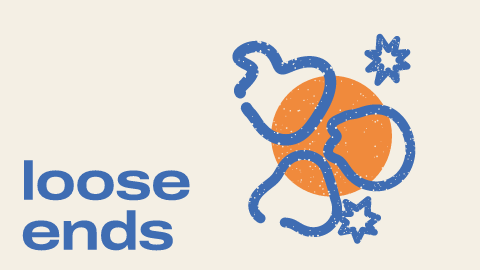

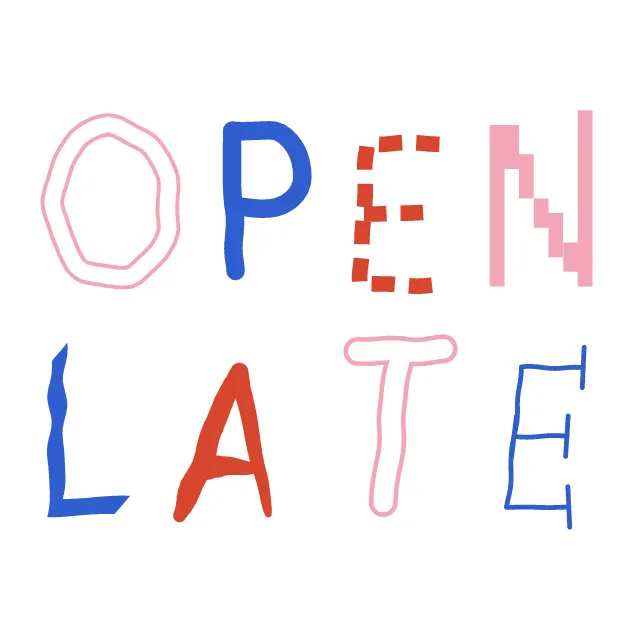
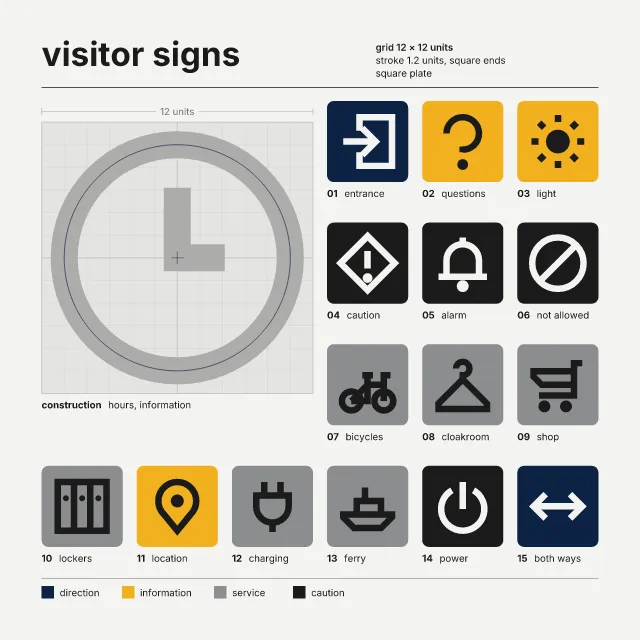
Marks drawn as one thick crayon line that loops over itself, with spiky stars, a flat shape behind and one word set wide. Or doodle your own.
What makes it Loop doodle
These are the design choices this generator makes or lets you set. Where a choice says “Measured”, Morphogeny changed that control alone, kept everything else, and measured the picture: a number that moves with the choice, not proof that the picture reads as the style.
- Outline drawing, engraving, pen and ink. “Layout”: Your doodle.
- Soft, cell-like, plant-like forms. “Marks”: Bubble outlines.
- Playful scribbles, dots and fragments scattered across the field. “Marks”: Free doodles.
- Unmodulated areas of colour. Set by “Shape behind”.
- Direct manual drawing and writing in ink. Always.
- Humour, games, visual puns. Always.
- Paper-white or pale fields dominate. Always.
- Neutral, rational sans: Akzidenz-Grotesk, Helvetica, Univers. Always.
How this generator works
- Every mark is one thick line traced once round a bubbly outline of a few lobes, throwing small cursive loops where it crosses itself and often ending in a curl; stars are drawn in the same crayon line.
- A flat shape with printed grain sits behind, and one word is set wide (across the foot, at the left of a wide sheet, or in the middle of a pattern); in motion the crayon takes up every line in turn and lays them down again, always forwards along the line.
What it never does:
- No letters of a real alphabet as marks, no faces or characters, and no logo of a real brand.
- No copy of a known identity: the opening is not a red line over a blue arch with a word across the top.
Every picture is a recipe: the variation number and the settings, kept in the page's address. Copy the link and the same picture comes back, in any browser. Random (or R) draws a new variation; ← and → step through them; S shuffles the settings; C borrows another style's colours.
About Natural Wine Label Art
Many young brands and club nights now use a hand-drawn mark in place of a logo: a loose, thick line in one bright ink, looping and curling, beside very plain wide type. The mark looks quick and personal, and the type keeps it tidy.
This generator draws each mark from code, never from an image model. A bubble outline of two to four lobes is traced once round in one line, which throws small cursive loops on the way and often ends in a curl. Free doodles wander in arcs instead and loop wherever they turn. Stars are drawn in the same line, and a flat shape with printed grain sits behind.
You can also doodle yourself: draw on the picture with your mouse or finger, and your lines are drawn again in the same crayon line. Every line, star and speck is a shape in the SVG.
Natural Wine Label Art: 2007–today. What the controls mean: Help.
One line, no lifting the pen
A doodle mark is drawn the way people doodle on the edge of a page: the pen goes down once and keeps moving. It goes round a shape, overshoots, curls back over itself and carries on. Where it crosses its own path a small loop appears, like the loop of a handwritten l.
That single line is what makes the mark feel personal. A shape drawn in one go has small accidents in it: a lobe a little too big, a gap where the line did not quite meet itself, a curl at the end where the hand slowed down. Drawn carefully with many strokes, the same shape would look stiff.
How the marks are made
A bubble mark starts as an outline: a base circle with two to four round lobes added at random angles, and sometimes a deep bite taken out, which turns it into a crescent or a heart. The line starts at a random point and goes round a little less or a little more than once, so it either leaves a gap or overlaps itself.
Loops are laid on the outline as a trochoid, the curve a point on a rolling wheel draws: the line rises, runs back across its own way up, and goes on. Each loop turns outwards or inwards. A free doodle has no outline: it is a chain of arcs that bend one way and then the other, with tight loops between them, and it turns back towards its start whenever it strays too far.
The line is drawn thick with round ends and joins, and specks of the paper show through it, more at its edges, as wax crayon leaves them on rough paper.
Doodling your own
Choose Your doodle and draw on the picture. Each stroke you make becomes one crayon line, smoothed a little so it reads as one movement of the hand. The shape behind is sized to what you drew, and the stars find room around it. Line weight sets how thick your lines are drawn.
Your doodle is saved in the link, so you can send it to someone or come back to it later. It stays where you drew it when you change the format, and a narrower format crops it rather than squashing it.
Setting up a poster
Poster puts a cluster of marks and stars over a flat shape, with your words set wide across the foot, on two lines in a tall format and at the left in a wide one. Pattern spreads marks and stars over the whole sheet and lets some run off its edges, round a clear space for the words. One mark draws a single large mark, for a profile picture or a sticker.
Loops sets how many cursive loops each line throws. Pencil sketch under adds the plain outline in pencil beneath the crayon, as in a designer’s working drawing. In motion the marks are drawn again one after another, always forwards along their line.
Use it from code
The recipe below draws the picture this page opens with. Copy recipe gives you the one on screen. Agents can render recipes to SVG or PNG through Morphogeny's MCP server (morphogeny_render); the same recipe always gives the same SVG.
{
  "tool": "loop-doodle",
  "v": 1,
  "seed": 7,
  "format": "portrait",
  "params": {
    "drawing": "",
    "words": "loose ends",
    "layout": "poster",
    "doodle": "bubble",
    "marks": 3,
    "loops": 2,
    "stars": 2,
    "shape": "pebble",
    "weight": 1.3,
    "sketch": false
  },
  "palette": "natural-wine-label"
}
Open this recipe: /loop-doodle/#seed=7&v=1. A plain-text version of this page:/loop-doodle.md.