



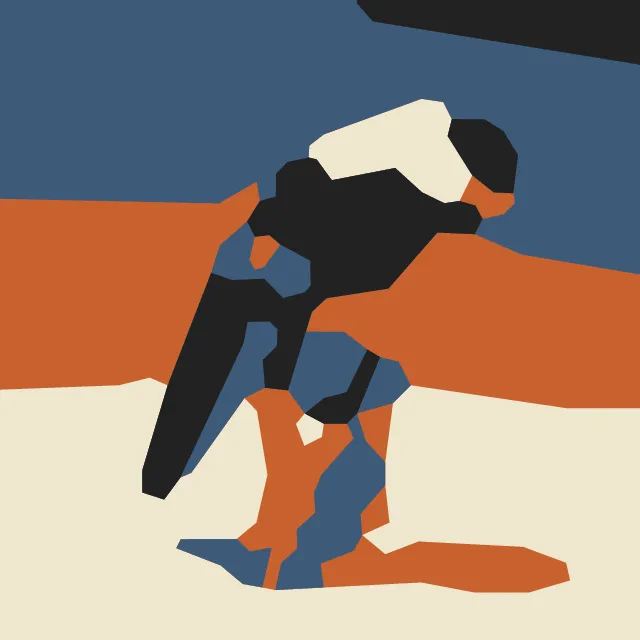
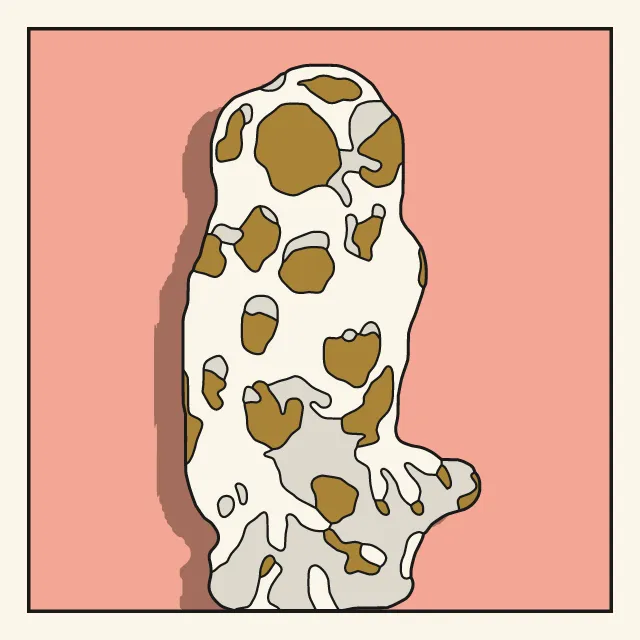
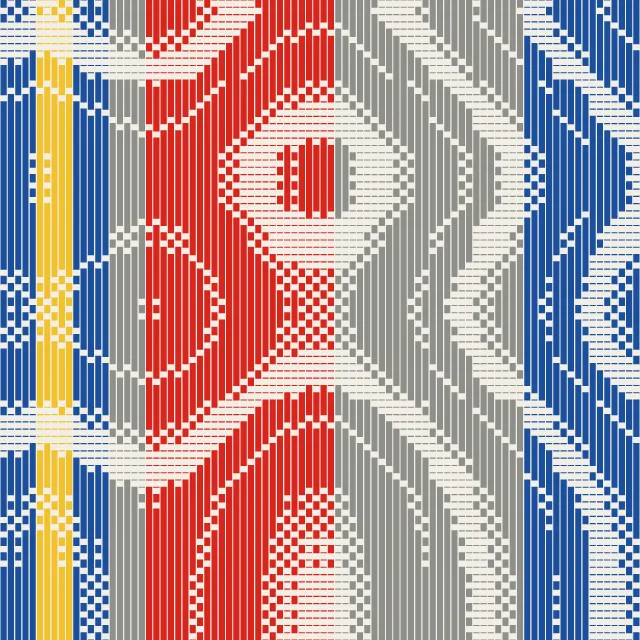
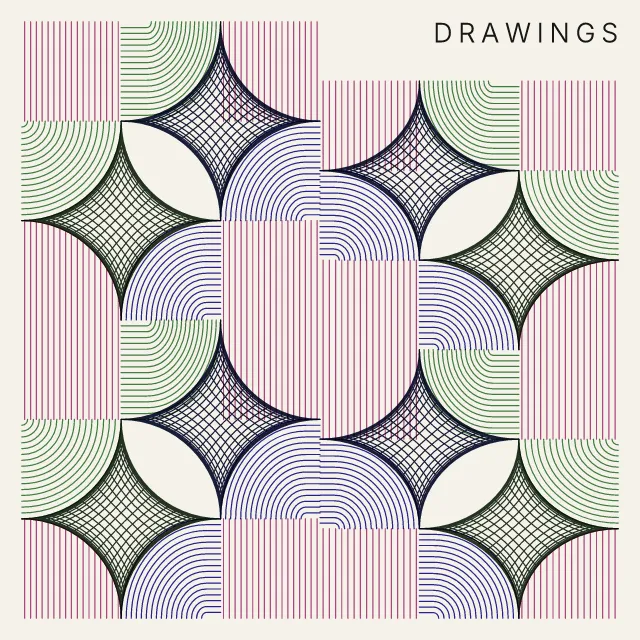





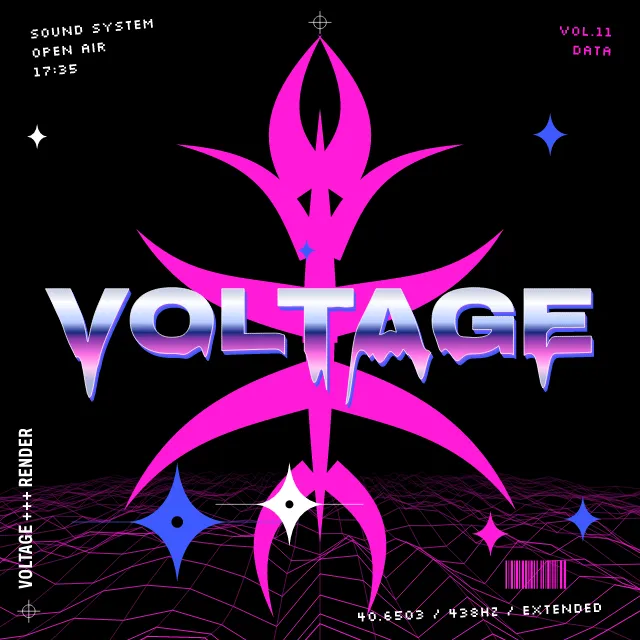





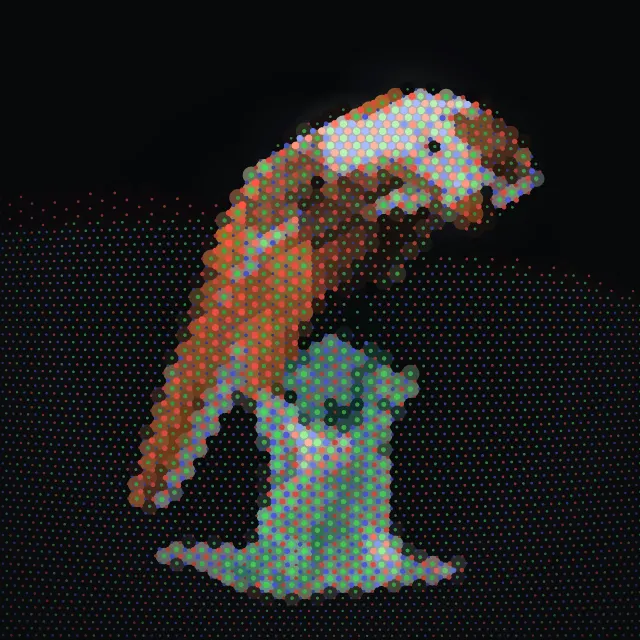

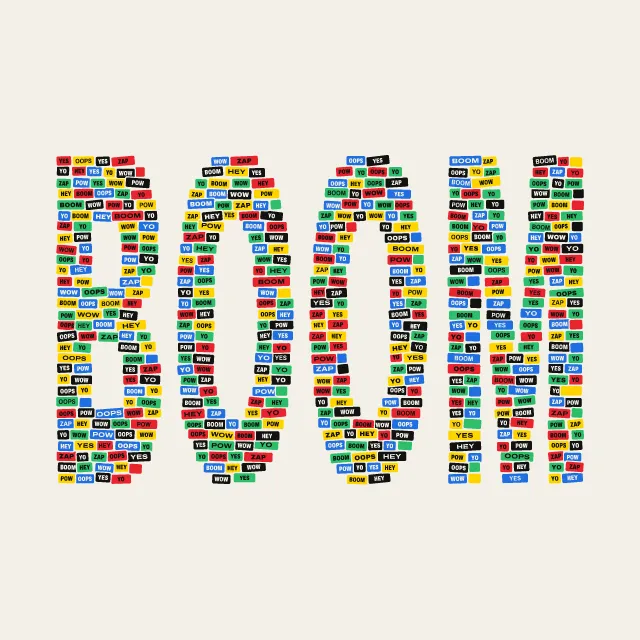

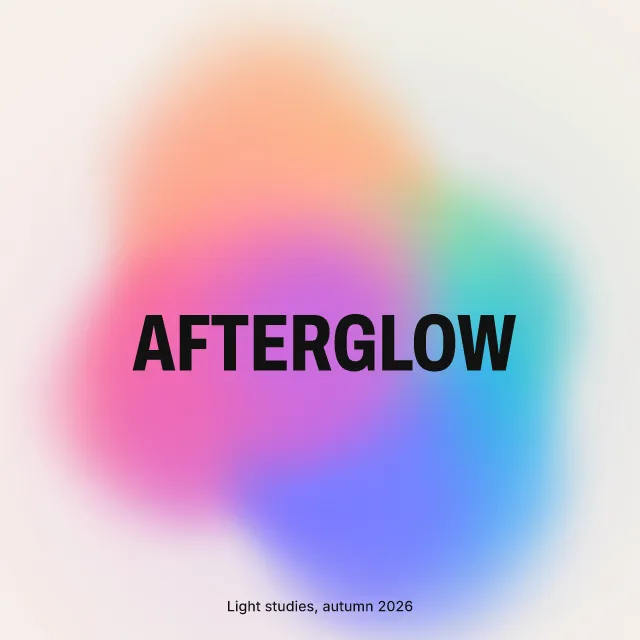


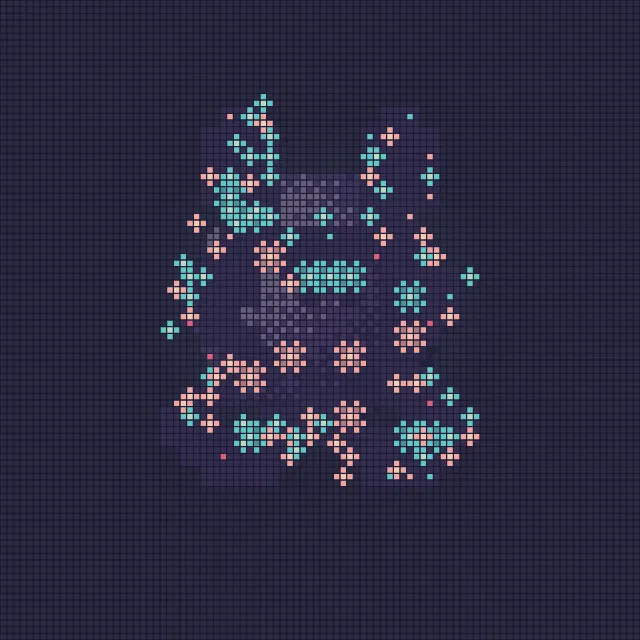

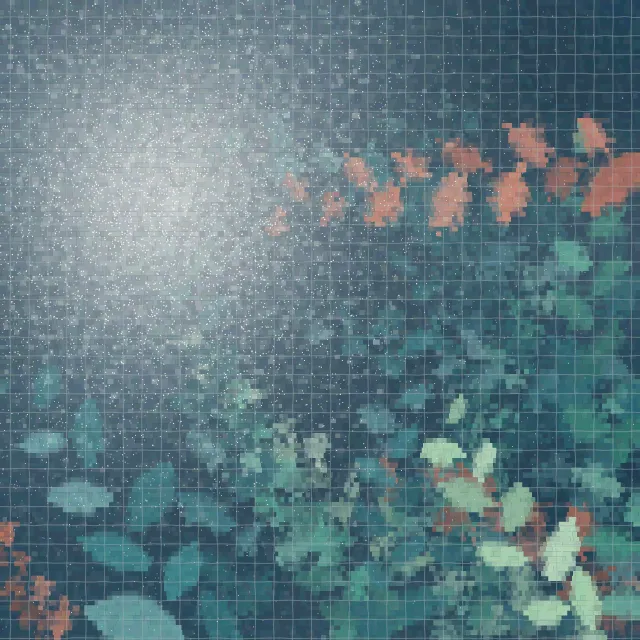
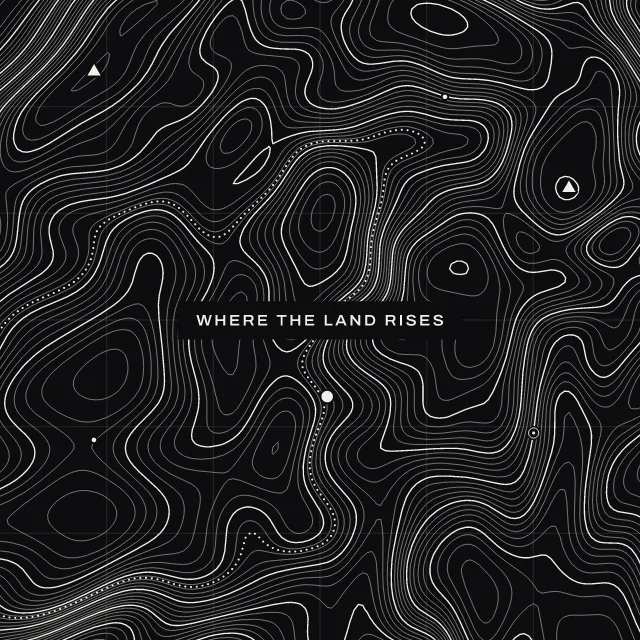
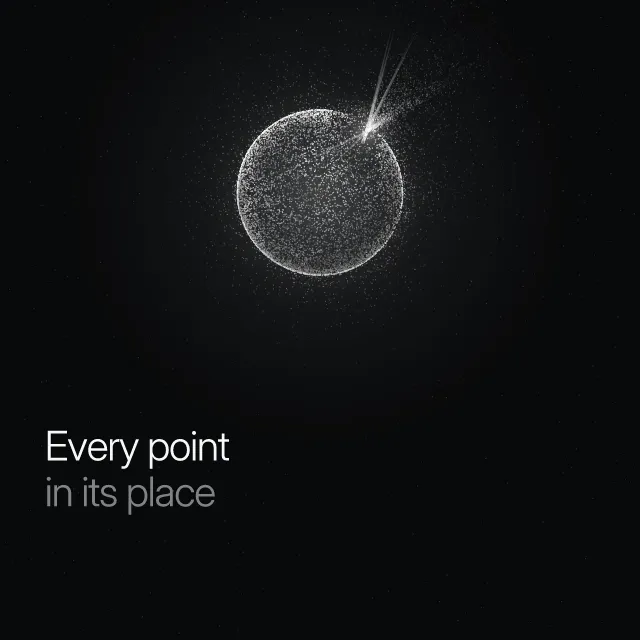






One living thing seen close on an empty ground, thin as tissue: a petal, a flower, flowers afloat, a halo, wings, ink in water or a veil of points.
What makes it Petals
These are the design choices this generator makes or lets you set. Where a choice says “Measured”, Morphogeny changed that control alone, kept everything else, and measured the picture: a number that moves with the choice, not proof that the picture reads as the style.
- Soft, cell-like, plant-like forms. Set by “Biomorphic curves”.
- Elements radiate from, or orbit around, a centre. “Biomorphic curves”: Flower.
- Perspective, overlap, shadow or parallax create a z-axis. “Biomorphic curves”: Afloat.
- Elements mirrored around a central axis; formal and stable. “Biomorphic curves”: Wings.
- Emptiness is an active element: wide margins and quiet areas. Set by “Generous white space”. Measured on the opening picture, from 0 to 1: ground showing 54% → 93%.
- Realistic, illusionistic rendering. Set by “Naturalistic depiction”.
- Smooth blends, fades or spectral ramps. Set by “Gradients”.
- Shifting, oil-slick or chromatic sheen. Set by “Iridescent & holographic”.
- Calligraphic stress and bracketed serifs: Jenson, Garamond, Bembo. Set by “Humanist & Garalde serif”.
- A single object or figure isolated on a plain ground. Always.
- One unmistakable point of entry. Always.
- Quiet, slow, meditative. Always.
How this generator works
- One living subject on an empty ground, drawn as thin tissue: each petal is shaded inside its own outline (pale throat, deeper rim, streaks, forking veins, a curled edge), and petals are a little translucent, so colour deepens where they overlap, and they glow at the rim on a dark ground.
- Detail is fine and dense where the subject is, and nowhere else: hair veins, scales, threads of ink, points of cloth, and glitter that lies only on the subject’s own surface.
- Space is distance: far, a specimen in a wide reserve; near, a close-up that slides off the sheet. Words are one small italic line, never a headline.
What it never does:
- No frames, panels, icons, grids or patterns; nothing repeats across the sheet.
- No species copied from a plate or a photograph, and no particular artist’s piece: forms are grown by the seed.
Every picture is a recipe: the variation number and the settings, kept in the page's address. Copy the link and the same picture comes back, in any browser. Random (or R) draws a new variation; ← and → step through them; S shuffles the settings; C borrows another style's colours.
About Biobrand (Organic Biotech CGI)
Since the early 2020s, biotech and wellness brands have shown one living thing, alone and close up, as the whole picture: a cell, a coral, a petal, a drop of colour spreading in water. The subject is set on a quiet white or black ground like a specimen, lit so that it seems to glow from inside, with a single small line of type beside it. The same look runs through calm, dreamy posts and phone wallpapers on social media.
This generator grows that kind of subject in code. Each petal is shaded inside its own outline: a pale throat, a deeper rim, soft streaks, hair veins that fork towards the edge, and sometimes an edge curled over with its shadow. Petals overlap as thin tissue: the colour deepens where two lie together, and on a dark ground the rims are bright. Wings, ink and the draped veil follow the same rule: fine detail on the subject and nowhere else.
Space sets the distance, from a small specimen in a wide reserve to a close-up that slides off the sheet. Every shape is a vector, so the SVG opens sharp at any size, and the same recipe always grows the same picture.
Biobrand (Organic Biotech CGI): 2021–today. What the controls mean: Help.
Where the soft specimen look comes from
Technology brands of the 2010s favoured cold, clean pictures: devices, gradients, white space. Around 2020, companies working with living materials, from bacteria to grown leather, began to show something else: rendered cells, corals and growths, soft and bodily, set apart on a plain ground like an object in a museum case. Design writers called it the look of biotech, and it spread to skincare, supplements and food.
At the same time, close-ups of petals, wings and ink in water became a staple of calm, contemplative accounts online, often with one short line of text over the picture. Some are photographs, some are made with 3D software and some with image models. What they share is a single subject, translucent and finely detailed, a ground left empty, and colour that fades from a glowing heart to a deeper edge.
How this generator draws translucent petals
A petal starts as a profile: a narrow claw at the base, widest past the middle, blunt or dipped at the tip, with its rim ruffled by smooth noise. Everything else is drawn inside that outline. A gradient runs from a pale throat through the petal’s colour to a deeper rim. A shade lies across it, heavier on the side away from the light, so the sheet reads as curved.
Wide soft streaks, some paler and some deeper, run from base to tip, and over them dozens of hair veins, each forking once or twice on its way to the edge. A soft band inside the rim is the edge of a thin sheet seen edge-on.
Flowers are rings of such petals round a heart of stamens or a tight spiral, seen from the front or at an angle. Afloat sets several at different depths: the deeper a flower lies, the further its colours move towards the water and the plainer it is drawn. The wings are built from veins that bow out from the root, with a glowing cell between each pair, rows of fine scales and pale spots in the dark margin.
Ink in water is a set of plumes that follow a slowly turning flow field: soft volumes of colour, a denser core where the ink is fresh, and thin veils whose one sharp edge gives ink its look. The veil is a sheet of several thousand points lifted into folds and lit from above. Height moves each point sideways too, so the folds lap over one another and the cloth looks dense where it doubles.
What to make with it
A tall picture with one small line across the middle makes a story, a phone wallpaper or a quiet post. A wide one with space round the subject suits the opening of a website for a clinic, a skincare range or a yoga studio. Square specimens on a white ground work as a set of covers or packaging tests, one subject each, and a close-up of a wing or a veil makes a background that holds a headline. In motion the petals open and close a little, the wings flex, the ink drifts and the veil sways, slowly enough to sit behind words.
Tips for a good specimen
Start from one of the ready looks and change one thing at a time. Choose the ground first: a pale palette gives the look of a pressed flower or a page from a field guide, a dark one gives the glow. Rotate moves the colours round and changes which one leads; Invert swaps a pale ground for a dark one. Lower Generous white space until the subject runs off the sheet for a close-up, where the veins and scales carry the picture; raise it for a small specimen in a wide reserve.
Keep Iridescent & holographic low for a calm picture; near its top the glitter crusts the subject, which suits a dark ground. Keep the line of words short, a few words at most, and let the subject do the rest.
Use it from code
The recipe below draws the picture this page opens with. Copy recipe gives you the one on screen. Agents can render recipes to SVG or PNG through Morphogeny's MCP server (morphogeny_render); the same recipe always gives the same SVG.
{
  "tool": "petals",
  "v": 1,
  "seed": 6,
  "format": "story",
  "params": {
    "subject": "petal",
    "space": 0.34,
    "veins": 0.6,
    "glow": 0.55,
    "ruffle": 0.45,
    "sparkle": 0.1,
    "words": "in its own time",
    "place": "centre"
  },
  "palette": "visual-kei-graphics"
}
Open this recipe: /petals/#seed=6&v=1&pal=visual-kei-graphics. A plain-text version of this page:/petals.md.